Advice
Is my loft strong enough for storage?
It depends on your joists, and they are checked for free before anything is priced. In most homes they were built to hold up a ceiling, not to carry much weight.
The survey is free and takes about twenty minutes. You get a written price before any work starts.
Do you check the joists before boarding a loft?
Yes. The free survey checks the joists before the job is priced.
The survey checks the joists before the job is priced.
You hear what the survey finds before you decide anything.
You get a written price before any work starts. It says what is included and what costs extra.
Were loft joists built to carry weight?
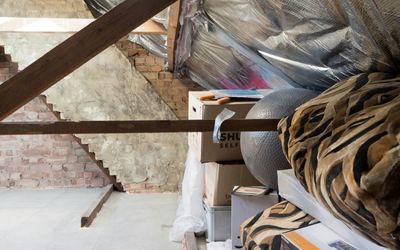
In most homes, no. The timbers you see across the floor of the loft are the ceiling joists of the rooms below. They hold the ceiling up and tie the roof together.
The Planning Portal, the national planning and building regulations site, puts it plainly. In most homes those joists will not have been designed to support a significant weight, and too much extra load from storage may take them past what they were designed for.
One eighth In the loading table the building regulations guidance uses, the weight assumed to be spread across a ceiling is one eighth of the weight assumed for a floor. That table is not a storage allowance for a loft. It shows how much less a ceiling is expected to carry.
So ceiling joists are not floor joists, and boarding a loft does not turn it into a room.
Sources: Planning Portal, building regulations for a loft conversion; Approved Document A: Structure, Table 4. All read 8 October 2026.How much weight can my loft hold?
We could not find an official weight limit in kilograms for an existing loft.
The companies that make raised loft floors publish limits of their own. One, Loft Leg, says up to 25kg per square metre, and that a structural engineer should confirm it.
That is the makers' limit for their own products. It is not a rule, and it is not a promise about your joists. The free survey checks the joists.
The same 25kg turns up in the building regulations guidance, as a ceiling load assumed when walls are designed. It is a design assumption, not a storage allowance.
Sources: Loft Leg; Approved Document A, Table 4. All read 8 October 2026.What if my roof is built with trusses?
Some roofs are built with trussed rafters: frames with a web of timbers inside them.
The Trussed Rafter Association says the lowest timber of a truss carries the ceiling, and that storage loads and water tanks are applied to it. That does not tell you how much yours were designed to carry.
The same body says trussed rafters must never be cut or trimmed unless a trussed rafter designer has specified it.
When do I need a structural engineer?
The free survey checks the joists. The survey check is not a structural engineer's calculation, so if there is any doubt, you will be told to get one. These three always need professional advice.
- You want to change the roof timbers. The Trussed Rafter Association says you need advice from an architect or structural engineer before modifying a roof structure.
- You want to store heavy things. Loft Leg, which makes raised loft floors, sets its limit at 25kg per square metre and says a structural engineer should confirm it.
- You want a room. A room needs building regulations approval. That is a loft conversion, and we can arrange those too.
The Planning Portal says laying boards over the existing joists may need a building control application, and that your local building control body can advise you.
Sources: Trussed Rafter Association, FAQs; Loft Leg; Planning Portal and its page on unimproved loft space. All read 8 October 2026.Can you store things in a new build loft?
Yes, with care. NHBC, which provides warranties on new homes, says stored items could restrict the air flow and get damaged by condensation, so keep the vents along the eaves, the low edges of the loft, clear. More on boarding a loft in a new build.
Source: NHBC, condensation in your roof space. Read 8 October 2026.Short answers
Can I use my loft as storage?
Yes, for light things. The Planning Portal says that in most homes the loft joists were not designed to support a significant weight, so spread things out and keep heavy items downstairs. What you can store in a boarded loft.
Are you allowed to store stuff in your loft?
Yes. The Planning Portal says boarding a loft for storage does not need planning permission. Laying boards over the joists may need a building control application. What can you store up there?
Do I need boards to store things in the loft?
Yes, that is the advice. Historic England says crawl boards or walkways should go in wherever you need to get into the loft to store things, or to look after tanks, wiring and aerials.
Does boarding protect the ceiling below?
It helps. Historic England says walkways reduce the risk of damage to ceilings, and of injury from stepping between joists.
How deep are loft joists?
It varies. Historic England's guidance uses joists 100mm deep as its example. Yours may be different, so they are checked at the survey.
What if I want a fixed staircase up to the loft?
That changes things. The Planning Portal says that putting in a stair and boarding the loft out is likely to need more work, and the building regulations are likely to apply. That is a loft conversion, and we can arrange those too.
Can you walk on a loft that is not boarded?
Not between the joists. Between them there is only the ceiling of the room below, and it will not take your weight. If insulation covers the joists you cannot see where they are, so stay off it.
Boards give you a floor to stand on, so you are not balancing on joists.

We reply within 24 hours.
Complete Loft Services sorts out loft boarding and insulation across Cambridgeshire and the surrounding counties. The survey is free, and you get a written price before any work starts.
Written by Ben Criddle, who runs Complete Loft Services. Published .