Advice
Is loft insulation flammable?
Mineral wool loft rolls are not: the glass wool and stone wool rolls we checked are declared Euroclass A1, the top class for reaction to fire. Some other materials are declared lower, down to class F.
The other half of the question is what sits under the insulation. Electrical Safety First says poorly installed downlights "are the cause of a significant number of fires in homes every year".
Does mineral wool loft insulation burn?
No. The plain glass wool and stone wool loft rolls we checked are declared A1, the highest class.
Mineral wool loft rolls come in two main kinds:
- Glass wool, often called fibreglass. Knauf Insulation's data sheet calls its glass wool loft roll non-combustible, with the best possible Euroclass A1 reaction to fire classification.
- Stone wool, often called rock wool. ROCKWOOL's data sheet says its stone wool rolls achieve the highest Euroclass A1 non-combustibility classification.
So a plain mineral wool roll will not feed a fire. That does not make everything around it safe, which is what the rest of this page is about.
Which type of loft insulation is best compares the materials.
Sources: Knauf Insulation, Loft Roll 40 and 44 data sheet; ROCKWOOL, Roll, Twin Roll and Rollbatt data sheet, version 1.03. Both read 11 November 2026.What do the fire classes A1 to F mean?
They say how much a material adds to a fire. A1 adds the least, F the most.
The government's fire safety guidance, Approved Document B, explains the scale. Reaction to fire is the degree to which a product will add to a fire as it breaks down. Products are classed A1, A2, B, C, D, E or F, with A1 the highest performance and F the lowest.
"Class F is assigned when a product fails to attain class E. Untested products cannot be classified in accordance with BS EN 13501-1."
Approved Document B, volume 1, Appendix B, paragraph B6.
Classes A2 to E can carry two extra marks:
- An "s" mark rates smoke. s1 means the least.
- A "d" mark rates flaming drips. d0 means the least.
Are other types of loft insulation flammable?
Some are. Each of these is declared a lower class than mineral wool by its own maker or certificate.
One sheep's wool roll is declared Euroclass E on its maker's data sheet. It passes the flammability and smoulder test the sheet lists, but E is a low class, so non-flammable overstates it.
One rigid PIR board sold for pitched roofs is declared reaction to fire class F in its maker's declaration of performance. That is the board on its own, as sold.
One multifoil's certificate gives it Class E and says it "will melt and shrink away from heat, but will burn in the presence of a naked flame."
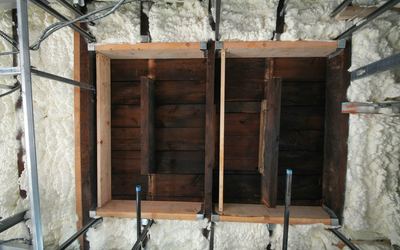
RICS calls polyurethane spray foam a combustible material. One open cell spray foam's certificate gives it Class E.
One blown cellulose maker declares its dry material C-s1, d0: class C, with the lowest smoke and drip marks.
A low class does not mean a material is banned from a loft. The spray foam certificate asks for a fire resistant lining board "In all applications other than in a non-habitable loft space", so in a loft used only for storage it can be left uncovered.
Even so, RICS says spray foam will increase the likelihood and extent of damage to your property and any adjoining properties if there is a fire. Spray foam in your loft: remove or keep?
Sources: Thermafleece CosyWool Roll data sheet, version 6; Kingspan Thermapitch TP10 declaration of performance, issue 005; BBA certificate 17/5388, YBS SuperQuilt; BBA certificate 20/5846, H2 Foam Lite E; RICS, spray foam insulation consumer guide; Warmcel technical data sheet. All read 11 November 2026.Can you cover downlights with loft insulation?
Not unless the fitting is made and rated for it. Check the fitting first.
Downlights are the lights set into the ceiling of the room below, with their backs poking up into the loft. They give off heat, and insulation laid over them traps it.
Electrical Safety First's advice:
- Do not let downlights touch or be covered by loft insulation or anything combustible "unless they are specifically designed and rated for such conditions, for example insulation-contact or fire-rated LED fittings."
- Downlights in a ceiling void should "have adequate clearance around them to allow for safe heat dissipation."
Its best practice guide for electricians is firmer still: "downlighters and any associated transformers must not be covered by thermal insulation." The same guide refers to "approved downlight loft covers", which let the insulation run over the top.
The Energy Saving Trust says that if you already have insulation, check that any recessed lights have insulation guards.
Sources: Electrical Safety First, downlights; Electrical Safety First, Best Practice Guide 5, issue 3.2; Energy Saving Trust, how to insulate a loft. All read 11 November 2026.Does a fire rated downlight mean it can be covered?
Not always. Check the fitting's own marking and instructions.
A fire rated downlight is about the hole in the ceiling. Electrical Safety First says these fittings "help maintain the fire resistance of the ceiling by sealing the opening in the event of a fire, slowing the spread of fire and smoke to adjacent areas."
It gives insulation-contact and fire-rated LED fittings as examples of downlights designed and rated to be covered, but only a fitting made and rated for it should be. The marking on the fitting, or the maker's instructions, is what tells you.
Changing to LED does not settle it on its own either. LED fittings vary, so the rating on the fitting is what counts. Electrical Safety First's advice is to "Use a registered electrician to install downlights." If you are unsure what your fittings are, that is who to ask.
Sources: Electrical Safety First, downlights. Read 11 November 2026.Is it safe to lay loft insulation over electrical cables?
Check first. The Energy Saving Trust says covering electrical or lighting cables with insulation is a fire risk.
Its guide to insulating a loft tells you to check for electrical or lighting cables before laying anything, because it is a fire risk to cover them. If in any doubt, speak to a qualified electrician.
The reason is heat. A cable warms up as it carries current, and insulation stops that heat escaping. NICEIC, which assesses electricians, explains that a cable clipped in place and then covered by insulation "for a length of at least 0.5 m" must have its current carrying capacity "reduced by half".
What NICEIC points out:
- The cables it worries about most are the heavily used ones. In its example of a bungalow loft, cables feed "a shower, cooker and/or ring final circuits", and the cable size "may no longer be adequate for the connected load."
- Most lighting circuits are unlikely to be affected. The bigger cables are the ones to have checked.
- Where PVC cables "are surrounded by polystyrene insulation", the PVC can harden, "leading to brittle insulation which may generate an increased risk of fire."
Moving or rerouting cables is a job for an electrician, not something to do while laying rolls.
Sources: Energy Saving Trust, how to insulate a loft; NICEIC, thermal insulation and its effect on flat twin and earth cables, in Professional Electrician. Both read 11 November 2026.Does it matter what is stored above the downlights?
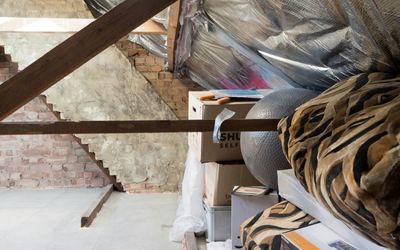
Yes. Boxes and bags over a hot fitting are the same problem as insulation over it.
A Hertfordshire building control leaflet from 2011 says that where a downlight's body is exposed in a loft used for storage, combustible things may be laid over it by accident. For that reason, it says it is good practice to fit clearly visible protective covers as a precaution.
A trade press report of fire investigators' findings gives one example: a roof fire caused by a downlighter that had been covered by Christmas decorations being put back into the loft.
Electrical Safety First's rule is not to let downlights "come into contact with, or be covered by, loft insulation or combustible materials unless they are specifically designed and rated for such conditions". What you can store in a boarded loft covers the rest.
Sources: Hertfordshire building control, Technical Guidance Leaflet 9, March 2011; Electrical Contracting News, 3 October 2011; Electrical Safety First, downlights. All read 11 November 2026.Do building regulations set a fire rating for loft insulation?
Not for the insulation on a house's loft floor, as far as we can find. The fire classes for insulation in Approved Document B are about external walls.
Approved Document B sets a minimum class for any insulation product in the external walls of:
- buildings with a storey 18m or more in height
- residential buildings with a storey 11m or more
We searched it for loft, roof space, insulation and downlight, and found no class set for insulation laid on the loft floor of a house.
On downlights, Electrical Safety First's guide notes that "Building Regulations do not prohibit the leaving of a small area around downlighters free from thermal insulation" where heat needs to escape. It says that should be allowed for in the home's overall heat loss.
A loft conversion is different: new rooms bring their own fire rules. Can you sleep in a boarded loft?
Sources: Approved Document B, volume 1: dwellings, paragraphs 10.6 and 10.7; Electrical Safety First, Best Practice Guide 5, issue 3.2. Both read 11 November 2026.Short answers
Is fibreglass insulation flammable?
No. Fibreglass is glass mineral wool, and Knauf Insulation's loft roll is declared Euroclass A1, the top class. The cables and lights under it are a separate question.
Do LED downlights need covers in the loft?
It depends on the fitting, not on LED. Electrical Safety First says not to cover a downlight with insulation unless it is designed and rated for it. Check the fitting's marking, or ask a registered electrician.
How can you tell if a downlight is overheating?
Electrical Safety First says to look for "discolouration, scorching, or curled labels" on and around the fitting, and to replace faulty or overheating fittings promptly.
Is polystyrene insulation safe next to cables?
NICEIC says PVC cables surrounded by polystyrene can turn brittle, which "may generate an increased risk of fire". Do not lay polystyrene against cables. If they already touch, ask an electrician: NICEIC's advice is to reroute cables above the insulation.
A warm loft without the worry
Plain mineral wool rolls will not burn. The things to check are the downlights and cables underneath, and the right person for those is a registered electrician.
With those sorted, we can get your loft insulated. The Energy Saving Trust recommends a depth of 270mm. The survey is free and takes about twenty minutes. You get a written price before any work starts.
Loft insulation top up: from £10 per m².
We reply within 24 hours.

Complete Loft Services sorts out loft boarding, insulation, ladders and hatches across Cambridgeshire and the surrounding counties. The survey is free, and you get a written price before any work starts.
Written by Ben Criddle, who runs Complete Loft Services. Published . Facts checked on .