Advice
Do the pipes and water tank need insulating when the loft is insulated?
Yes. Insulation keeps the warmth in the rooms below, so the loft above gets colder. Any tank or pipe up there is then more likely to freeze. The Energy Saving Trust says they need insulating too.
Wrap the tank on its sides and top, and leave the space under it bare. Lag the pipes up there, including the cold pipe that rises into the loft.
Why do pipes freeze once the loft is insulated?
Because the heat that used to leak up from the house now stays below the insulation.
"Insulating between and over the joists will help keep your home warmer, but it also makes the loft space above much colder."
Energy Saving Trust, roof and loft insulation.
A colder loft is not a problem in itself. But pipes and water tanks up there are then more at risk of freezing in winter. Without their own insulation, they could freeze.
Freezing matters because water grows as it turns to ice. The pressure builds on the pipes and joints, and pipes can split or joints pull apart. For more on what happens to the loft once it is insulated, see how much loft insulation you need.
Sources: Energy Saving Trust, roof and loft insulation (last updated 8 May 2026); Department of Energy and Climate Change, loft insulation factsheet; WaterSafe, how do I protect against frozen pipes. All read 10 November 2026.Should you insulate under the water tank in the loft?
No. Leave the ceiling under the tank bare, so warmth from the rooms below can reach it.
Insulate the tank around the sides and top, but not underneath. Insulation under the tank stops warm air reaching it, and that could make it freeze. The same advice comes from:
- the Energy Saving Trust's step by step guide
- Cambridge Water and Anglian Water, which supply most of Cambridgeshire
- the current NHBC standard for new homes (clauses 7.2.15.4 and 8.1.3.4)
NHBC adds that a raised tank in a cold roof space is insulated on each side. Its drawing shows the tank's own insulation lapped over the loft insulation, so there is no gap at the bottom edge.
Sources: Energy Saving Trust, how to insulate a loft (last updated 15 October 2025); Cambridge Water, wrap up for winter; Anglian Water, before winter sets in. All read 10 November 2026. NHBC Standards 2026 (nhbc.co.uk, sign in required), clauses 7.2.15.4 and 8.1.3.4 and figure 57, read 10 November 2026.How do you insulate a cold water tank in a loft?
A jacket round the sides and over the top, a lid that fits, and a safe way to reach it.
Use a British Standard insulating jacket, made to fit over the tank. Or wrap the top and sides in suitable insulation material.
The tank needs a rigid lid that fits closely and is fixed securely. It should keep out light, birds, vermin and dust.
If the tank is far from the loft hatch, have secure boards to walk on. See boarding over loft insulation.
An old cement tank may contain asbestos. Water tanks are one of the places it can be found. It is often best left where it is, especially if it is in good condition and unlikely to get damaged.
Sources: Energy Saving Trust, roof and loft insulation; WaterSafe; Water Regs UK, design requirements for cold water storage cisterns; Drinking Water Inspectorate, water storage tanks and cisterns; HSE, asbestos FAQs. All read 10 November 2026.Is a loft water tank required to be insulated?
Yes. The water fittings regulations ask for every cold water storage tank to have a cover and insulation.
Under the Water Supply (Water Fittings) Regulations 1999, a storage tank needs:
- a cover placed to keep out light and insects
- "thermal insulation to minimize freezing or undue warming"
Every water fitting should also be installed so that frost or anything else is less likely to damage it.
Note the words "undue warming". The insulation keeps the water cool in summer as well as frost free in winter. The right level of insulation should stop the water going above 20°C.
Stored water should be kept as cold as practicable. So a tank jacket is not there to keep the water warm.
If you own your home, insulating and protecting all the pipework inside is your job, says East Cambridgeshire District Council. In a rented home, it falls to the landlord.
Sources: Water Supply (Water Fittings) Regulations 1999, schedule 2, paragraphs 4 and 16(4); Water Regs UK, what protection against freezing is required; Drinking Water Inspectorate; East Cambridgeshire District Council, leaks and burst pipes. All read 10 November 2026.Do pipes in the loft need lagging?
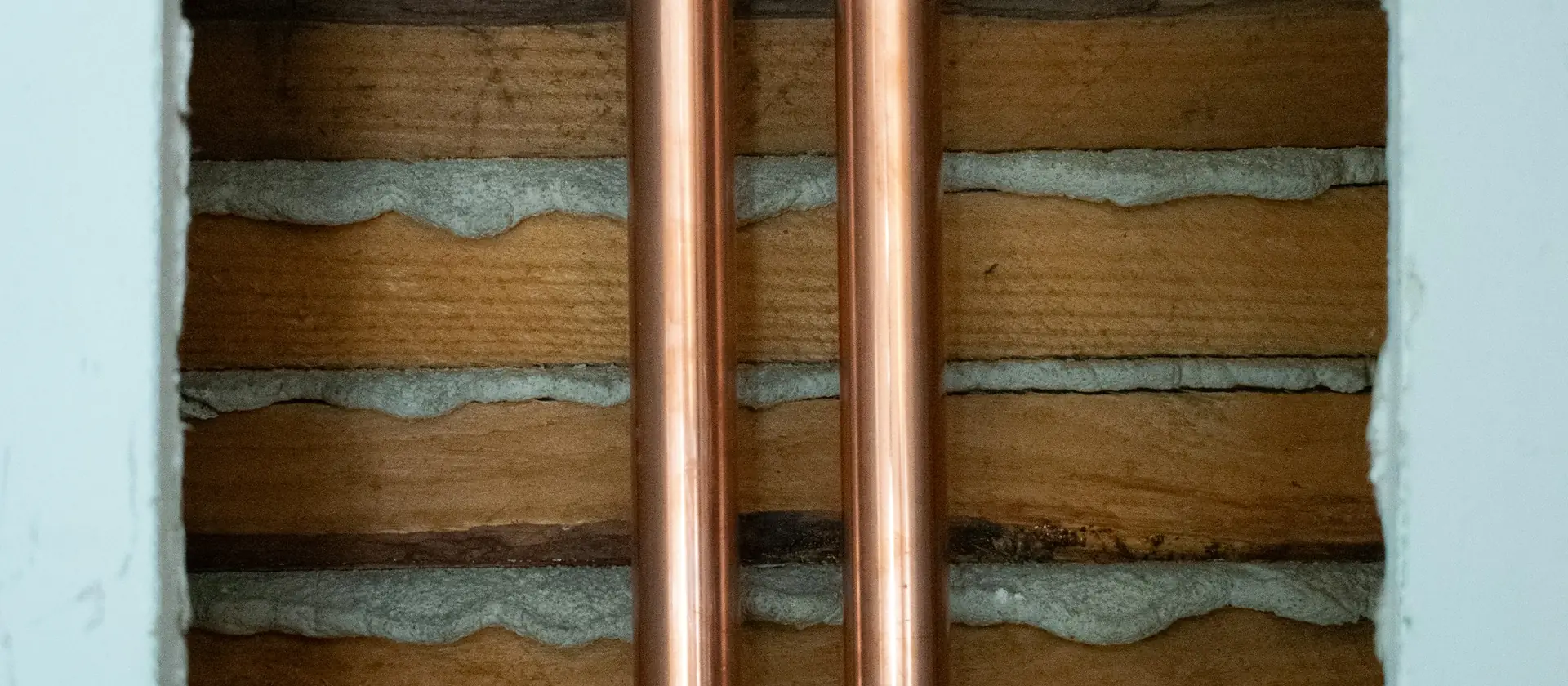
Any pipe that sits above the loft insulation does. Pipes tucked down under it are better placed, and the cold water pipe coming up into the loft still wants lagging.
Wrap pipes in foam pipe insulation, which can be cut to size and is easy to fit. WaterSafe goes further and asks for all pipes in unheated areas like lofts to be insulated.
For new homes, NHBC says water pipes should go below the main roof insulation where possible. The cold pipe rising above ceiling level should be insulated even where it is below the main insulation (clause 7.2.15.4).
Gaps are where pipes freeze first. To avoid them:
- leave no gaps in the lagging at bends, valves or fittings
- at a bend, cut notches or join two pieces
- "secure and seal each end of the insulation with tape"
How thick should pipe lagging be in a loft?
Thicker than you might expect. There is no single household figure, and lagging slows freezing rather than stopping it.
Choose the thickest insulation that will fit around your pipe. The right thickness comes from the maker's technical details, with BS 5422 as another source. Water Regs UK warns that insulation "may delay but not prevent freezing".
NHBC prints a frost table for cold water pipes in new homes, taken from BS 5422 (clause 8.1.3.4, table 1). For a 15mm pipe it gives:
- 30mm of insulation with a 0.025 W/mK material
- 62mm of insulation with a 0.035 W/mK material
The lower the W/mK figure, the better the material insulates. Those thicknesses are worked out to delay freezing for 12 hours with the air at minus 6°C, allowing up to half the water to turn to ice. So even well lagged pipes can freeze in a long cold spell.
Sources: Energy Saving Trust, insulating tanks, pipes and radiators; Water Regs UK, what protection against freezing is required. Both read 10 November 2026. NHBC Standards 2026 (nhbc.co.uk, sign in required), clause 8.1.3.4, table 1, read 10 November 2026.Do you need a cold water tank in the loft?
Not every home has one. Older homes often do, and newer ones are often fed straight from the mains.
Many older homes have a cold water storage tank in the loft. In newer homes, especially those with unvented heating systems, all the hot and cold taps are likely to run straight off mains pressure.
Whether your own tank can go depends on your heating and hot water system, so that is a question for a plumber.
No tank does not always mean nothing to protect. If any water or heating pipe crosses the loft above the insulation, it is in the cold.
Source: Drinking Water Inspectorate, water storage tanks and cisterns. Read 10 November 2026.What do the building regulations say about pipes in the loft?
Approved Document L covers heating pipes passing through a roof void. It says nothing about cold water pipes or tanks.
The current Approved Document L asks for new heating pipework to be insulated where it passes outside the heated living space, including into voids (paragraph 4.24). The 2026 edition takes effect on 24 March 2027 and spells it out:
"This includes where pipework passes through a void outside the heated living space, such as a roof void or ground floor void."
Approved Document L, volume 1, 2026 edition, paragraph 3.25.
Both are about new heating systems and heat loss. Frost protection for cold water pipes and tanks sits with the water fittings regulations above. For whether you have to insulate the loft itself, see is loft insulation a legal requirement.
Sources: Approved Document L, volume 1, 2021 edition incorporating 2023 amendments, paragraph 4.24; Approved Document L, volume 1, 2026 edition, paragraph 3.25. Both read 10 November 2026.Short answers
Should I open the loft hatch when it is freezing?
Only for a short time. East Cambridgeshire District Council suggests opening it on cold days to let warm air circulate.
But Northern Ireland Water says it should be "a temporary measure ONLY, as it will cause condensation". NHBC also says not to leave the hatch open for long periods. Lagging the tank and pipes is the lasting fix. Should a loft hatch be insulated?
Can I get free pipe lagging in Cambridgeshire?
Cambridge Water says its customers can claim free pipe lagging from Get Water Fit. Check its page for the current offer.
What if I am going away in winter?
If you will be away for a while, WaterSafe suggests turning off your water supply and draining the system. Cambridge Water suggests keeping the heating on low, at no lower than 14ºC, through the night and while you are out.
Does insulating the roof instead of the floor stop the freezing?
It helps. With the roof insulated, the loft is warmer, so freezing tanks and pipes are less of a worry. But insulating at rafter level is much less energy efficient than insulating the loft floor, says the Energy Saving Trust.
Insulate the loft, then protect what is up there
A warmer house means a colder loft. Jacket the tank on its sides and top, leave the ceiling under it bare, and lag the pipes up there, including the cold pipe that rises into the loft.
We can get your loft insulated to the 270mm the Energy Saving Trust recommends. The survey is free and takes about twenty minutes. You get a written price before any work starts.
Loft insulation top up: from £10 per m².
We reply within 24 hours.

Complete Loft Services sorts out loft boarding, insulation, ladders and hatches across Cambridgeshire and the surrounding counties. The survey is free, and you get a written price before any work starts.
Written by Ben Criddle, who runs Complete Loft Services. Published . Facts checked on .